
Dancing With Myself: A Conversation with Janine Kovac
Janine Kovac is a former professional ballet dancer who writes about power dynamics and women’s bodies. She is the author of Brain Changer: A Mother’s Guide to Cognitive Science, Spinning: Choreography for Coming Home, and most recently The Nutcracker Chronicles: A Fairytale Memoir. Her distinctions include fellowships from Hedgebrook, MacDowell, and the San Francisco Foundation/Nomadic Award for Nonfiction. She lives in Oakland with her family.
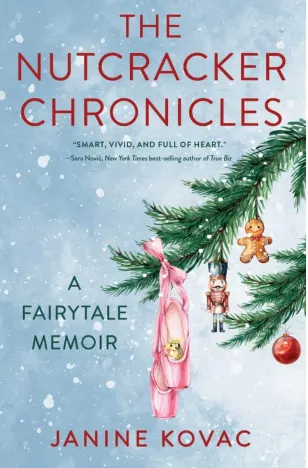
The creation of The Nutcracker Chronicles grew out of years of reflection on life in ballet. Janine Kovac has been writing about dance for most of her life, drawn to the contrast between the intense physical and emotional labor behind the scenes and the polished performances seen by audiences. Over time, those observations developed into a deeper narrative framework built around The Nutcracker as both story and metaphor.
A key turning point came in 2014, during a personal conversation that revealed how closely real-life experiences of dancers mirrored the themes of the ballet itself. From that moment, Kovac began connecting her own memories, her husband’s experiences, and her children’s exposure to dance into a larger conceptual structure. Although the idea was present for years, she only committed fully to the project in 2020, completing it over the following two and a half years.
Writing with vulnerability and honesty
A central concern in Kovac’s memoir is emotional transparency. The work does not avoid difficult topics such as envy, insecurity, financial instability, and bodily change—realities often hidden behind the aesthetic perfection of ballet.
She explains that many chapters began as independent essays written over several years. This allowed her to gradually test how personal and revealing the material felt before assembling it into a larger narrative. One recurring tension was how people from her past would react, especially former teachers, directors, and peers.
Some readers recognized shared memories or gained new perspectives on events they had experienced differently at the time. Others felt uncomfortable, interpreting the work as a critique of ballet culture. These conflicting responses reinforced her decision to continue writing honestly rather than soften the realities she had lived through.
Audience perception and artistic identity
Kovac reflects on the long-standing pressure dancers feel to be perceived a certain way. Over time, she learned that external approval is unpredictable and shifting, and that performance becomes more grounded when it is rooted in authenticity rather than audience expectation.
That realization carried directly into her writing practice. She describes authenticity as a guiding principle—something that helps her connect with readers and other artists without trying to shape perception in advance. For her, writing is not about controlling how the work is received, but about remaining truthful to the experience being described.
Structure and non-linear storytelling
The memoir’s non-linear structure mirrors the symbolic logic of The Nutcracker. Rather than following a strictly chronological path, the narrative moves between time periods to emphasize thematic connections—particularly around family, authority, identity, and transformation.
Kovac did not set out to create a fragmented timeline from the beginning. Instead, the structure evolved as she worked with the metaphor of ballet itself. The story of Clara receiving a nutcracker and entering another world became a flexible framework through which personal memory and artistic interpretation could intersect.
Early influences and academic path
Before focusing fully on dance, Kovac was influenced by her father’s work in psychology. This early exposure helped her interpret complex interpersonal dynamics within ballet environments, particularly those shaped by authority and discipline.
Later, she studied cognitive science, including psychology courses that deepened her interest in human behavior. However, despite these academic influences, she did not ultimately pursue a career in psychology, instead continuing on the artistic path that began in childhood.
Cultural transitions and personal development
Kovac’s experiences living in different countries also shaped her perspective as both an artist and individual. Her time in Iceland offered an introduction to cultural adaptation, while her later move to Italy required deeper immersion, including language learning and adjustment to new social rhythms.
These experiences broadened her understanding of identity beyond performance. She describes this period as one that helped her reconnect with embodied experience—food, pace of life, and daily presence—elements that later informed her writing style and thematic interests.
Lessons from ballet
Ballet provided a framework for discipline, observation, and resilience. Kovac emphasizes that one of the most lasting lessons from dance is the ability to continue performing under pressure, even in moments of fatigue or emotional difficulty.
She also highlights the importance of interpreting feedback critically—distinguishing between useful guidance and noise. Over time, this skill became essential not only in dance but also in writing, where revision and external critique play a central role.
Writing and belonging
When discussing her writing career, Kovac reflects on earlier assumptions about who literary spaces belong to. Over time, she came to see the field as far more diverse and open than she initially believed. Rather than seeking approval from a narrow gatekeeping structure, she now focuses on finding communities and readers who are genuinely receptive to her work.
This shift created a more stable sense of belonging—one based on alignment rather than permission.
Identity after ballet
Leaving ballet opened space for new intellectual and personal pursuits, including computer science, family life, and broader creative exploration. Rather than feeling like a loss of identity, the transition became an expansion of it.
She describes this period as a time of rediscovery, where questions that had previously been set aside could finally be explored without the constraints of a demanding performance schedule.
Motivation and endurance
Both ballet and long-term relationships, she notes, share a similar structure of persistence. Success moments create emotional momentum, encouraging continuation even when the process becomes difficult. In dance, it is the pursuit of a perfect performance; in relationships, it is the ongoing effort to sustain connection and understanding.
This interplay between difficulty and reward becomes a driving force in both artistic and personal life.
Writing challenges and creative direction
The most difficult aspect of writing the memoir was not only emotional distance from her younger self, but also the structural challenge of aligning personal narrative with the abstract framework of The Nutcracker. Certain sections of the ballet do not follow traditional narrative progression, which required creative adaptation.
Ultimately, she resolved this by balancing thematic structure with a more grounded chronological approach focused on family and lived experience.
Creative influences and future work
Kovac draws inspiration from literature with unconventional structures and from classical music, particularly the layering techniques of composers. She values works that reward repeated reading and reveal new layers over time.
Looking ahead, she is working on new fiction projects set in Oakland and West Marin, exploring themes such as philanthropy, social tension, and moral conflict within communities.
Other Articles